Morocco

Crossroads of Culture

A 5-Week Gap Year Program

building at pink sunset

35 Days

Gain exposure to the different languages, faiths, and cultures that create the cultural crossroads that intersect in Morocco. For students interested in exploring the historical and contemporary influences in North Africa while gaining valuable insights into Islam, migration, and Arabic language.

Journey across Morocco, uncovering deep cultural, historical, and religious connections.

From the rise and fall of empires to the cross-cultural exchanges that have left an indelible mark on the broader region, this program emphasizes patterns of migration, international relations, and the cultural & religious influences across continents. By following the path of conquests, intellectual growth, and artistic achievements, we will gain a profound understanding of how history has placed Morocco at the center of a cultural crossroads.

teenager learning to sew

Highlights & Outcomes

Learn Cultural Arts

Apprentice in rug weaving, shoemaking, dance, and traditional carving with expert local mentors

Travel Off the Beaten Path

Trek in the Atlas Mountains while learning outdoor skills, travel to remote villages, and traverse ancient trade routes

Practice Moroccan Arabic

Practice Moroccan Arabic and French through immersive, interactive lessons and daily practice

Engage Contemporary Global Issues

Discuss the role of Islam, women’s rights, migration, and geopolitics with local experts

ancient Moroccan ruins
line drawing of Morocco

Your Journey Starts Here

Our journey begins among the sacred hilltop towns and ancient medinas of northern Morocco, where winding alleyways, lively markets, and centuries of layered history offer an introduction to this complex and dynamic country. As we settle into the rhythms of daily life, we begin studying Darija, exploring Islamic traditions, and examining the diverse influences that have shaped Moroccan identity.

Moving between cities and rural communities, we experience Morocco through homestays, conversations with local experts, and meaningful engagement with the people and places we encounter. In Marrakech, we navigate the sensory pulse of the ancient medina before traveling into the High Atlas Mountains, homeland of Morocco’s Indigenous Amazigh people. In the lush Ait Bougamez Valley, we stay with local families, learn about Amazigh traditions and contemporary issues, and trek through dramatic snow-capped mountain landscapes.

Throughout our travels, students take increasing ownership of the program, culminating in a student-led travel phase shaped by the group’s interests. Through language learning, rugged travel, homestays, and cross-cultural exchange, students explore questions of culture, identity, faith, and change while developing greater independence, self-awareness, and a deeper understanding of Morocco and our interconnected world.

Itinerary Example

Morocco Semester

Itinerary Example
The following is a sample itinerary based on past courses; actual itineraries are dynamic and may vary.
  • Week 1

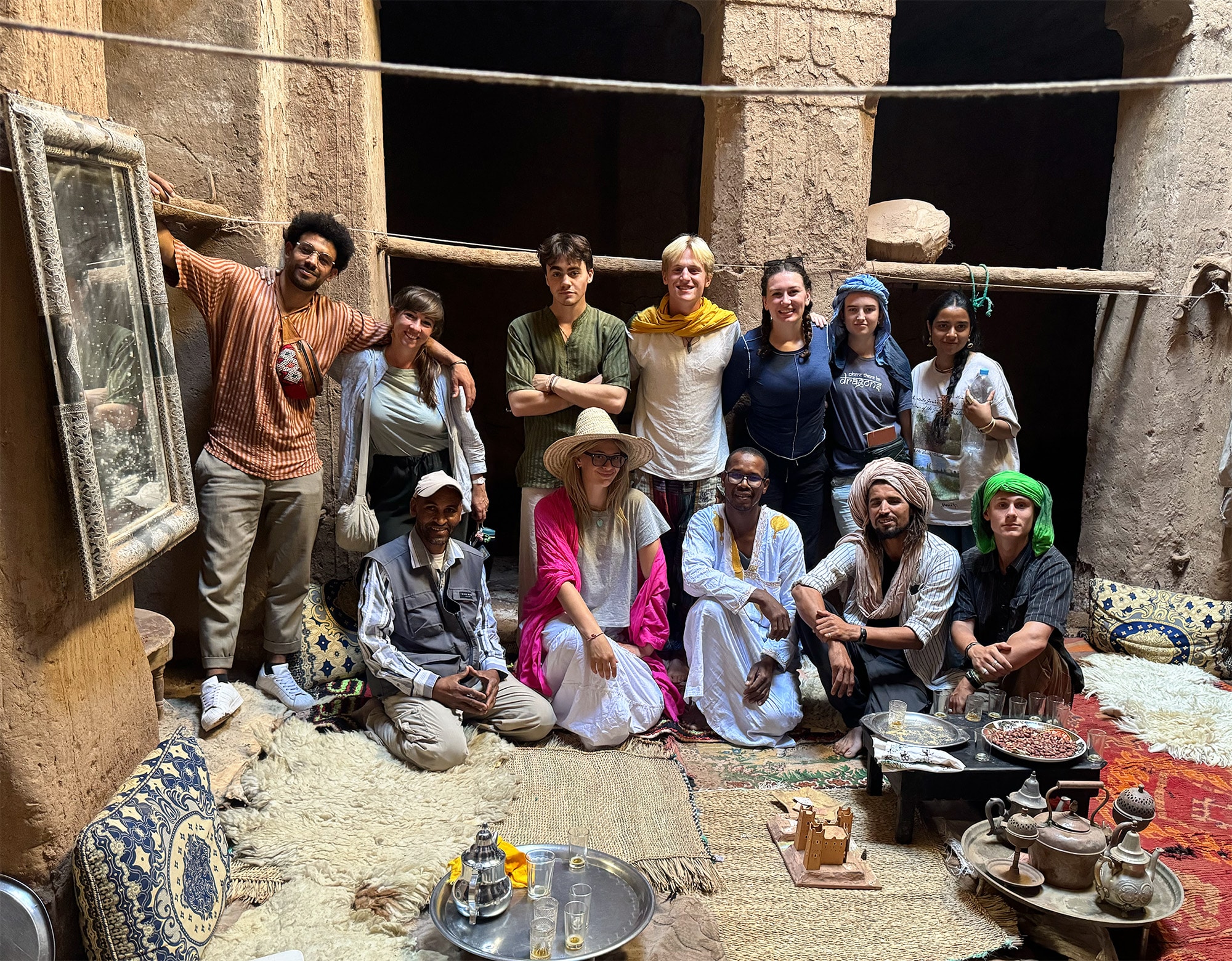
    Group gathered in Morocco
    group sitting at tables in courtyard

    Our journey begins in Casablanca before traveling inland to Moulay Idriss Zerhoune, a sacred hilltop town surrounded by rolling countryside. Here, we slow down after our travels, get to know one another, establish our group culture, and begin exploring questions of Moroccan identity, history, and Islam. We venture to the nearby Roman ruins of Volubilis before continuing to Fes, where the winding streets of the ancient medina become our classroom. We explore the ancient Jewish Quarter, navigate bustling markets, and inevitably get a little lost among the old city’s thousands of alleyways.

  • Week 2

    Morocco
    girl learning to weave in Morocco

    From Fes, we board a train west to Rabat, Morocco’s political and administrative capital, where students settle into their first homestay. Living with Moroccan families offers a window into everyday life and an opportunity to move beyond observing culture to participating in it. Our days include Darija language lessons, Independent Study Projects, guest speakers and excursions around the city, while evenings and weekends create space to connect with host families. As our language skills and cultural confidence grow, so does our ability to navigate Morocco with greater independence.

  • Week 3

    After saying goodbye to our Rabat families, we turn south toward Marrakech. The city’s palaces, gardens, souks, and the constant energy of Jemaa el-Fnaa introduce another side of Moroccan life. Here, students begin taking greater ownership of the journey through a “Mini X-Phase,” working together to navigate the city and help shape portions of our programming. It’s a chance to practice the decision-making, communication, and travel skills they’ll need later in the course. From the bustle of Marrakech, we leave Morocco’s urban centers behind and make our into the High Atlas Mountains.

  • Week 4

    girl pouring tea into glass cup with another girl smiling and boy holding tea in background
    people standing in canyon water

    Traveling through Azilal and into the lush Ait Bougamez Valley, our focus shifts toward Morocco’s Indigenous Amazigh culture and the relationship between people and place. We connect with local cooperatives and organizations, hike to waterfalls, and settle into a rural homestay with Amazigh families. Students experience the rhythms of village life, explore apple orchards and surrounding fields, visit local markets, and share seemingly bottomless cups of sweet mint tea. Students say goodbye to their host families with a haidus, a traditional dance, before a multi-day trek through the dramatic mountain landscapes of the M’Goun valley.

  • Week 5

    person painting mosaic type art
    sheep in front of blue and white cabins

    Coming out of the mountains, the group applies five weeks of language learning, cultural awareness, budgeting, navigation, and collaborative decision-making to help plan and lead the final segment of our program. Where we go is intentionally left open: perhaps toward the dunes of the Sahara, the windswept Atlantic coast, or another corner of Morocco that has captured the group’s curiosity. Instructors provide support and boundaries, but students increasingly become the architects of this final phase of our travels. As our journey draws to a close, we reflect on the relationships we’ve built, the challenges we’ve navigated, and how our understanding of Morocco and ourselves has evolved along the way.

Religious & Spiritual Traditions

Explore the culture and practices which surround Islam in Morocco. Learn about historical and contemporary perspectives on faith through local visits, guest speakers, and daily observations. Investigate the role of women in Islam, the history of Judaism in the country, and how religion impacts every-day life in different parts of the country.

Language Study

Immerse yourself in the five key languages across Morocco: Darija (Moroccan Arabic), Modern Standard Arabic, Amazigh languages, French, and Spanish to gain a deep understanding of Morocco’s linguistic and cultural diversity. Study Darija and Spanish through regular lessons which focus on developing key communication abilities. As we move into Spain, we’ll uncover the relationship between Spanish and Arabic.

Rugged Travel

Travel by shared van, bus, train, and the ubiquitous “grand taxi” from North to South. Trek and camp in remote areas in High Atlas mountain villages and stay in homestays with limited amenities. Cross the Strait of Gibraltar by ferry to move between continents and continue our journey through Spain.

Social & Environmental Justice

Learn about the Moroccan monarchy, explore Morocco's progressive legislation aimed at improving the lives of women, and investigate the issues of water management and land-use. Through first-hand observations, observe the effects of tourism and the disparity between development in different areas of the country. Engage with discussions about deforestation and access to the environment in Spain.

Independent Study Project

Choose a topic of interest to investigate independently such as indigenous language, traditional instruments, crafts such as embroidery or Islamic art, cooking, henna, or human migration.

Homestay

Spend at least two weeks living with a family in an semi-urban environment and 1-2 weeks in a rural homestay where the mountains meet the desert in the south of Morocco. During treks, camp alongside nomadic families who make their home in the High Atlas Mountains. Possible additional group homestays throughout the program.

Trekking

Spend around 5 days trekking in the remote High Atlas and Middle Atlas Mountains which are home to numerous different Amazigh and Tuareg communities. Participate in day-hikes in the Fez or Tangier region as well, exploring ancient tombs and caves. Move through various rock formations and forests in Andalucia, Spain.

Learning Service

Learn directly from local community association members and see how they identify and carry out projects to improve the opportunities of local youth, artisans, or women.

Optional College Credit

To deepen your experience abroad, you may choose to enroll in optional college-level coursework during the program. Those who enroll will be invoiced for an additional college credit fee on top of the program cost.

Students who take a college credit course will receive an official transcript from our university School of Record upon successful completion of the program. Taking advantage of the college credit option may make 529 plan funds eligible toward the entire program cost.

Learn About College Credits

Through our School of Record, you have the option to enroll in 1-3 of the following courses for college credit:

  • COLS 191: Self & Culture in Experiential Cohorts
  • CTE 191: Introduction to Leadership Development
  • CTE 292: Introduction to Ethical Volunteering
See Course Offerings

Meet a Few of Our Instructors

Experienced educators. Community builders. Life mentors. With deep regional expertise and local language fluency, our instructors are skilled at providing context for the student experience and building cultural bridges. We collectively draw upon personal networks to create opportunities for connection and guide students along their journey.

Meet Our Instructors

Frequently Asked Questions

More Questions About Gap Year Travel?

See All Gap Year FAQs

Let's Connect

Schedule a Call

Request a Catalog

Dive Deeper